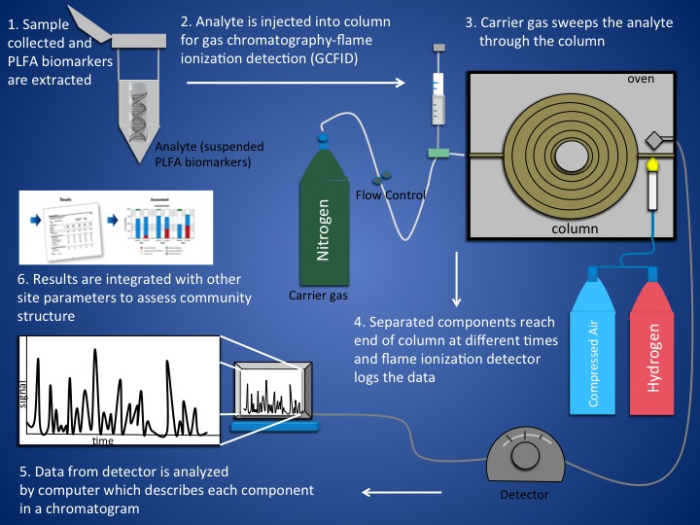
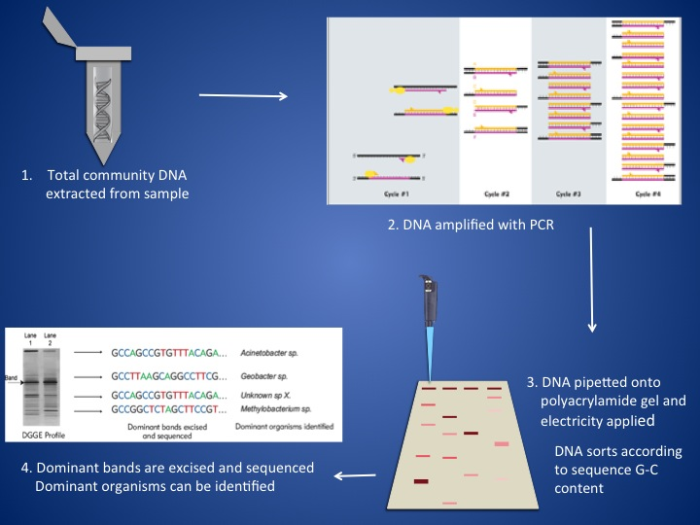
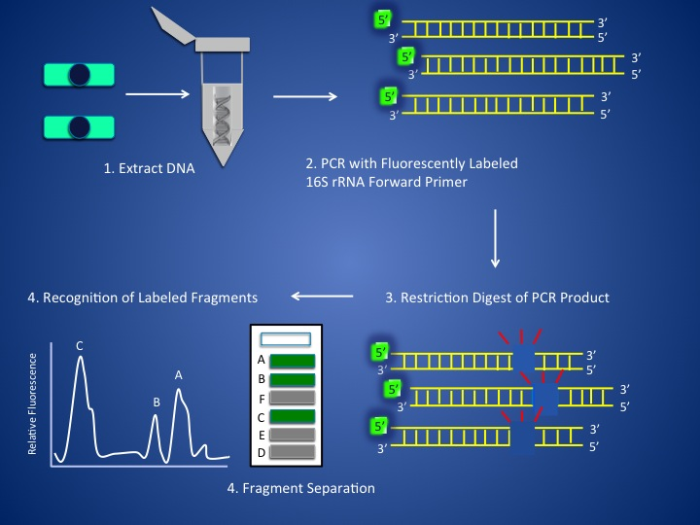
Interpretation of most site monitoring data, including microbial fingerprinting, is most conclusive when based on comparisons to corresponding results for background (non-impacted, upgradient) or baseline (prior to treatment) samples. For example, PLFA results showing an increase in total biomass relative to baseline levels indicate microbial growth in response to the treatment approach. Likewise, comparison of baseline DGGE to post-treatment DGGE profiles can reveal which microorganisms or types of microorganisms were enriched by the treatment approach as well as those which may no longer be dominant following the shift in subsurface conditions. In other words, the comparison is used to determine the impact of the treatment approach on the overall microbial community composition. Other EMDs such as qPCR (if available) may be more appropriate for tracking numerical and functional changes in specific microbial populations in response to treatment. Overall, the central lesson learned in microbial fingerprinting for environmental restoration applications is that analysis of background or baseline samples is invaluable for productive interpretation of results. Additional information about fingerprinting methods is included in the fingerprinting fact sheet.
5.3.3.1 Choosing between PLFA, DGGE, T-RFLP, and other EMDs
The primary difference in the results provided by each technique is in the degree of resolution or specificity. Choosing between these techniques therefore depends primarily upon the specificity of the questions that need to be addressed and the current state of knowledge regarding the microbial process in question.
Fingerprinting methods are used to provide an overall view of the microbial community, indications of microbial diversity, insight into the types of metabolic processes occurring in the sample (notably the terminal electron accepting processes, such as sulfate reduction), and some can be used to identify a subset of the microorganisms present in the sample. This information is relevant because biodegradation inherently depends upon the types and abundance of microorganisms present in the subsurface. For example, microbial fingerprinting methods can identify when adverse conditions (such as low pH), either natural or following a remedy such as chemical oxidation, result in low microbial biomass and rendering biodegradation unlikely under existing conditions. Similarly, microbial fingerprinting methods can be used to determine if the overall microbial community has recovered or responded to remedial actions. While other EMDs are more appropriate to detect and quantify known contaminant degrading microorganisms, several microbial fingerprinting techniques can be used to identify the predominant microorganisms present in the sample.
Genetic fingerprinting methods are not quantitative, and many important microbial processes are conducted by a numerically small portion of the total population (<1%) that may not be detected by fingerprinting techniques. T-RFLP may be more sensitive than DGGE for detecting less abundant microorganisms, but it is still limited for such uses as compared to more specific methods such as PCR. Interpretation of microbial community fingerprints is somewhat subjective and less straightforward than for other EMDs and identification is limited to known microorganisms and available DNA sequences.
PLFA analysis provides a measure of total viable bacterial biomass and a broad-based profile of the microbial community composition grouped into general categories. PLFA analyses can provide information on the changes in the community without determining the exact species composition, since a change in the PLFA pattern should indicate an altered community. PLFA analysis can address general questions such as whether a treatment increased or decreased total bacterial biomass or substantially altered redox conditions.
DGGE and sequence analysis provides a DNA-based profile of the microbial community and allows identification of the predominant organisms generally to the family or genus level but cannot quantify specific organisms or microbial functions. DGGE profiles are used to visually display differences or shifts in microbial community composition over time or in response to treatment. Subsequent sequence analysis is somewhat exploratory, seeking to identify specific types of organisms. Most often, DGGE analysis is performed when identification of the predominant organisms is required but little is known about the microbial community of the sample prior to analysis. Although DGGE can be used to identify microorganisms (unlike PLFA, for example), the number of microorganisms that can be identified depends on the complexity of the microbial population. Typically, only three to ten microorganisms can be identified per sample.
While the DNA-based microbial fingerprinting methods (DGGE, T-RFLP) are used to identify microorganisms present in a sample, other EMDs provide more specific results and may be more appropriate for evaluating contaminant biodegradation. For example, qPCR provides very specific results—quantification of a specific microorganism (for example, Dhc) or genes encoding a specific function (reductive dechlorination of vinyl chloride) responsible for biodegradation of common groundwater contaminants. In these cases where site management questions focus on evaluating biodegradation of a specific contaminant or group of compounds, other EMDs such as qPCR are often more applicable.
5.3.3.2 Pyrosequencing
Despite their relative ease of performance, some common DNA-based fingerprinting techniques such as T-RFLP and DGGE have biases that can oversimplify the diversity in complex microbial communities. For example, T-RFLP analyses cannot differentiate terminal fragments (and consequently microbes) that share the same restriction site. Similarly, amplified gene fragments that contain more than one base difference sometimes cannot be effectively separated by the denaturing conditions used in conventional DGGE analyses.
Like many other molecular approaches, DNA-based fingerprinting methods are likely to be replaced by approaches that exploit the increasing availability of low cost, high throughput DNA sequencing methods (see Appendix D.4 ). Current DNA sequencing methods such as pyrosequencing enable the sequencing of many thousands of PCR-amplified DNA segments from an environmental sample (see Appendix D, Question 28). Subsequent analyses of the resulting DNA sequencing data enables the relative abundance of different phylotypes to be determined for the microbial community captured in the DNA sample. These analyses are often much more comprehensive than methods such as T-RFLP and DGGE, and have the added bonus of providing the identity of microbes in addition to relative abundance and diversity. The low cost of these analyses is driven by not only rapidly decreasing DNA sequencing costs, but also by the automation of much of the analysis and by simultaneously conducting multiple analyses using barcoded PCR primers.
As with other EMD methods, however, these sequencing methods can have bias or errors. For example, during pyrosequencing error can be introduced within the DNA sequences generated, which can increase the potential to overestimate microbial diversity (Kunin et al. 2010). However, better bioinformatic tools continue to emerge to deal with and even eliminate the errors during sequencing and sequence data processing. (Quince et al. 2009; see Logares et al. 2012 for a review). Other “next-generation” high throughput sequencing approaches (such as, platforms known as Illumina®, SOLiD®, Ion Torrent™, PacBio, Starlight) are also being rapidly developed in parallel to pyrosequencing, often as research tools, but are also commercially available (see Glenn 2011 for a recent review).